

An interest rate is not a single number that can be interpreted on its own. On the same day, the policy rate, a bond yield, a deposit rate, a commercial loan rate and a consumer loan rate are different rates attached to different transactions.
This note explains which rate a company can use, and for what purpose, when comparing loan offers.
The purpose of this explanatory note is:
- to set out the difference between nominal, effective and real interest;
- to read the policy rate, TLREF, bond yields and commercial loan rates within the same framework;
- to assess a loan offer together with maturity, collateral, fees, tax and the repayment schedule;
- to compare the all-in cost of Turkish lira and foreign-currency loans under exchange-rate scenarios;
- to provide the conceptual framework needed to choose a discount rate consistent with the currency of the cash flow, its inflation content and its risk profile.
Before using an interest rate, four questions have to be asked. Which transaction is being measured? In which currency? For which maturity? Is the rate a flow or a stock, and which costs does it include?
- Which transaction? The policy rate, a deposit rate, a bond yield and a commercial loan rate represent different transactions. For a working-capital loan offer, the rates on similar commercial loans are the more appropriate benchmark.
- Which currency? Turkish lira and dollar rates show the cost in their own currencies. A company whose revenue is in lira should also compute the lira equivalent of principal and interest when assessing a dollar loan.
- Which maturity? Quoting a rate on an annual basis does not mean that the transaction has a one-year maturity. A one-week repo rate and a two-year bond yield can both be expressed annually.
- Flow or stock, and which costs are included? A flow rate is the rate on new loans extended in a given period; a stock rate is the rate applied to outstanding loan balances. A loan offer should also be checked for whether fees, tax and other compulsory charges are included in the quoted rate.
1. The Concept of Interest and Types of Interest Rate
Interest is the price of using a fund for a specified period. The party that supplies the fund forgoes the opportunity to consume, to place the money in another investment, or to hold it liquid over the same period. The interest paid in addition to principal at maturity compensates for that forbearance and also for default, liquidity and maturity risk.
The interest rate is the common language of economic decisions. It makes visible, in the same framework, the return a saver requires in order to postpone consumption, the minimum expected return on an investment a company will finance with debt, and the compensation a bank requires against credit risk. That common language can mislead if the nature of the transaction being measured is not known.
1.1. Nominal interest
Nominal interest is interest stated without adjustment for inflation. Even when a contract quotes an annual rate, the length of the interest period, the day count, the timing of payment, the compounding method, tax and fees can change the true cost. On a six-month deposit quoted at 36 per cent nominal per year, simple interest and an exact half-year assumption produce gross interest of 18 per cent; the net amount depends on tax and the terms of the contract.
1.2. Effective interest
The effective rate is the annual rate that results when periodic interest is compounded over the year. If periodic interest is added to principal and the next period’s interest is calculated on the increased balance, the same nominal rate produces a higher effective return or cost when interest accrues more frequently.
Annual effective interest = (1 + k / m)m − 1
Here k is the annual nominal rate and m is the number of equal compounding periods in a year. The table below shows the equivalent of a 36 per cent nominal annual rate under different compounding assumptions.
Table 1. The effect of compounding frequency on 36 per cent nominal interest
| Accruals per year | Periodic rate | Annual effective rate |
|---|---|---|
| 1 (annual) | 36.00% | 36.00% |
| 2 (semi-annual) | 18.00% | 39.24% |
| 4 (quarterly) | 9.00% | 41.16% |
| 12 (monthly) | 3.00% | 42.58% |
For 36 per cent nominal interest compounded quarterly, the periodic rate is 36 / 4 = 9 per cent. After four periods the sum grows by a factor of (1.09)4 = 1.4116. The annual effective rate is therefore approximately 41.16 per cent.
1.3. Real interest
The real rate shows the change in purchasing power once the effect of inflation has been removed from the nominal rate. The simple difference between the nominal rate and inflation is a quick calculation, but it contains an error. When the interest rate and inflation are high, and the gap between the two is large, the Fisher equation, which reflects the compound relationship, should be preferred.
Fisher equation: 1 + k = (1 + r) × (1 + e) → r = (1 + k) / (1 + e) − 1
k is the nominal rate, e is inflation and r is the real rate. All three must be used for the same period and in decimal form. If the nominal rate is 36 per cent and annual inflation is 29.77 per cent, the difference of 36 − 29.77 = 6.23 percentage points is an approximation. The Fisher calculation, 1.36 / 1.2977 − 1, gives a real return of approximately 4.80 per cent.
Table 2. Subtraction compared with the Fisher result
| Pairing | Nominal | Inflation | Subtraction | Fisher |
|---|---|---|---|---|
| Policy rate and October 2026 CPI | 36.00% | 29.77% | 6.23% | 4.80% |
| Two-year bond and October 2026 CPI | 39.46% | 29.77% | 9.69% | 7.47% |
| Policy rate and the 12-month-ahead expectation | 36.00% | 24.04% | 11.96% | 9.64% |
| High-rate assumption | 72.00% | 40.00% | 32.00% | 22.86% |
As the nominal rate rises, the product r × e becomes material. At 5 per cent interest and 2 per cent inflation the gap between the two approaches is limited; at 72 per cent interest and 40 per cent inflation, subtraction gives 32 per cent and the Fisher approach 22.86 per cent. Ignoring the compound relationship in a high-inflation setting can therefore become a decision error.
1.4. Realised and expected inflation
When an investment decision is taken, the expected real return is calculated with the inflation expected over the life of the investment. When the term ends, the realised real return is measured with realised inflation. The two calculations are not the same: the first records the expectation at the moment of decision, the second the change in purchasing power that actually occurred.
With the 24.04 per cent inflation expected twelve months ahead in the November 2026 survey of market participants, the Fisher real equivalent of the 36 per cent policy rate is approximately 9.64 per cent. The calculation that uses the 29.77 per cent annual CPI realised in October 2026 gives approximately 4.80 per cent. The difference comes from the inflation measure that is used.
2. The Components of a Market Interest Rate
To understand the nominal interest on a debt, the rate should not be treated as a single risk premium. In a simplified decomposition, nominal interest is the joint result of the risk-free real rate, the expected inflation premium, default risk, and liquidity and maturity premiums. Reinvestment risk should also be considered separately, especially for short-term investments that are rolled over frequently.
Nominal interest ≈ k* + IP + DRP + LP + MRP
k* is the risk-free real rate (the pure rate of interest), IP the inflation premium, DRP the default-risk premium, LP the liquidity premium and MRP the maturity premium. Because these elements can overlap, separating them one by one from a market price is difficult; the formula is above all an analytical frame of thought.
2.1. The risk-free real rate and the inflation premium
The risk-free real rate (the pure rate of interest) is the return expected from an investment whose default risk can be disregarded, after the effect of inflation has been removed. In other words, it shows how much the investment is expected to increase purchasing power by the end of its term.
The nominal yield on a government bond shows how much the money invested will increase in money terms by maturity. Estimating how much of that increase will be reflected in purchasing power requires an inflation forecast matched to the bond’s maturity. If a one-year government bond yields 30 per cent nominally and expected inflation for the same year is 25 per cent, the expected real return is 1.30 / 1.25 − 1 = 4 per cent. If the bond’s default risk and the other risk premiums embedded in the yield can be disregarded, that 4 per cent can be used as an approximate indication of the risk-free real rate.
The inflation premium compensates for the loss of purchasing power in money to be received in the future. In October 2026, annual CPI was compiled at 29.77 per cent, the monthly increase at 2.58 per cent, core C at 28.28 per cent and domestic PPI at 27.41 per cent. The forward rates of 24.04 per cent and 18.02 per cent indicate that inflation is expected to decline over time. The two-year bond yield also reflects maturity and risk premiums on top of those expectations.
2.2. Default, liquidity and maturity premiums
The lender prices the possibility that the borrower will fail to pay principal or interest on time. A commercial-loan average of 46.25 per cent excluding overdrafts and corporate cards, against a roughly two-year Treasury yield of 39.46 per cent, does not mean that the 6.79 percentage-point gap consists only of the company’s default risk. Maturity, the mix of transactions, bank expenses, reserve requirements, taxes, the cost of capital and the profit target may also sit in the difference.
The liquidity premium concerns how quickly an asset can be sold, when needed, at a price close to the market price. In a thinly traded bond the investor requires extra yield to compensate for the price concession that may arise on sale. The maturity premium is the compensation for bearing interest-rate and inflation uncertainty for a long time.
On 17 November 2026, two-, five- and ten-year Turkish lira Treasury yields were 39.46, 39.43 and 36.60 per cent respectively. The ten-year yield standing 286 basis points below the two-year yield shows that the yield curve slopes downward. That shape can be explained by the expectation that short-term rates will fall in the future outweighing the maturity premium.
2.3. CDS and credit risk
A five-year credit default swap (CDS) is the premium paid to buy protection against a borrower’s default. Türkiye’s five-year CDS premium in dollars was 257 basis points on 3 November 2026 and 234 basis points at the close on 13 November. 234 basis points means roughly 2.34 dollars a year of premium on a 100-dollar notional amount.
The Turkish lira bond yield can remain high while the CDS premium falls. The CDS prices mainly the cost of credit protection on foreign-currency debt, whereas the lira bond jointly prices lira inflation, the Central Bank’s interest-rate path, local liquidity and lira maturity risk.
3. The Central Bank’s Interest-Rate Set
The central bank uses its policy instruments in pursuit of price stability. Under a floating exchange-rate regime, the short-term interest rate is one of the main transmission channels of monetary policy. The policy rate affects the price of banks’ central-bank funding and expectations about market rates; it does not, however, automatically equalise every bank loan with the policy rate.
3.1. The policy rate and the interest-rate corridor
Under decision no. 2026-45 of 22 October 2026, the one-week repo rate was cut from 37 to 36 per cent, the overnight lending rate from 40 to 39 per cent, and the overnight borrowing rate from 35.50 to 34.50 per cent. The start of implementation is given as 23 October 2026.
Table 3. Selected monetary-policy and overnight-market indicators
| Indicator | 18 November 2026 | Function |
|---|---|---|
| Policy rate | 36.00% | The rate applied in one-week repo auctions. |
| Overnight borrowing | 34.50% | The lower band, at which the CBRT borrows overnight from banks. |
| Overnight lending | 39.00% | The upper band, at which the CBRT lends overnight to banks. |
| Late liquidity window | 0% / 42% | Overnight borrowing / lending facility between 16:00 and 17:00. |
| Weighted-average funding | 36.00% | The amount-weighted cost of funds actually obtained from the CBRT. |
| TLREF | 35.5687% | The Turkish lira reference rate calculated from secured overnight repo transactions. |
The corridor between 34.50 and 39 per cent is 450 basis points. The policy rate stands 150 basis points above the lower band and 300 basis points below the upper band. When funding is provided mainly through weekly repo auctions, the weighted-average funding cost can approach the auction rate; if the funding mix changes, the average cost changes as well.
3.2. The late liquidity window
The Late Liquidity Window (LLW) helps a bank that faces an unexpected liquidity shortfall at the end of the day to find overnight funds against collateral. From 23 October 2026 the LLW lending rate is 42 per cent and the borrowing rate is 0 per cent. The 42 per cent rate is 3 percentage points above the overnight lending rate and 6 percentage points above the policy rate.
That gap encourages banks to meet their daily cash needs earlier in the day. Although the LLW provides an overnight bridge, it creates a repayment obligation on the next business day; it is therefore also part of the bank’s funding plan for the following day.
4. Bond Yields and the Yield Curve
The yield curve shows, on a given date, the yields of debt instruments of the same currency and similar credit risk, arranged by maturity. When the two-, five- and ten-year yields on Turkish lira Treasury bonds are placed on the same chart, maturity is on the horizontal axis and the annual yield on the vertical axis. It matters that the yields used to draw the curve are calculated by the same method. If an annually compounded yield and a simple annual rate are used on the same chart, the difference across maturities can be misleading.
The level of the curve shows where rates stand, in general, across maturities. Its slope is the difference between long and short yields. If the two-year bond yields 39.46 per cent and the ten-year bond 36.60 per cent, the ten-year yield is 2.86 percentage points, or 286 basis points, below the two-year yield. The curve then slopes downward between two and ten years.
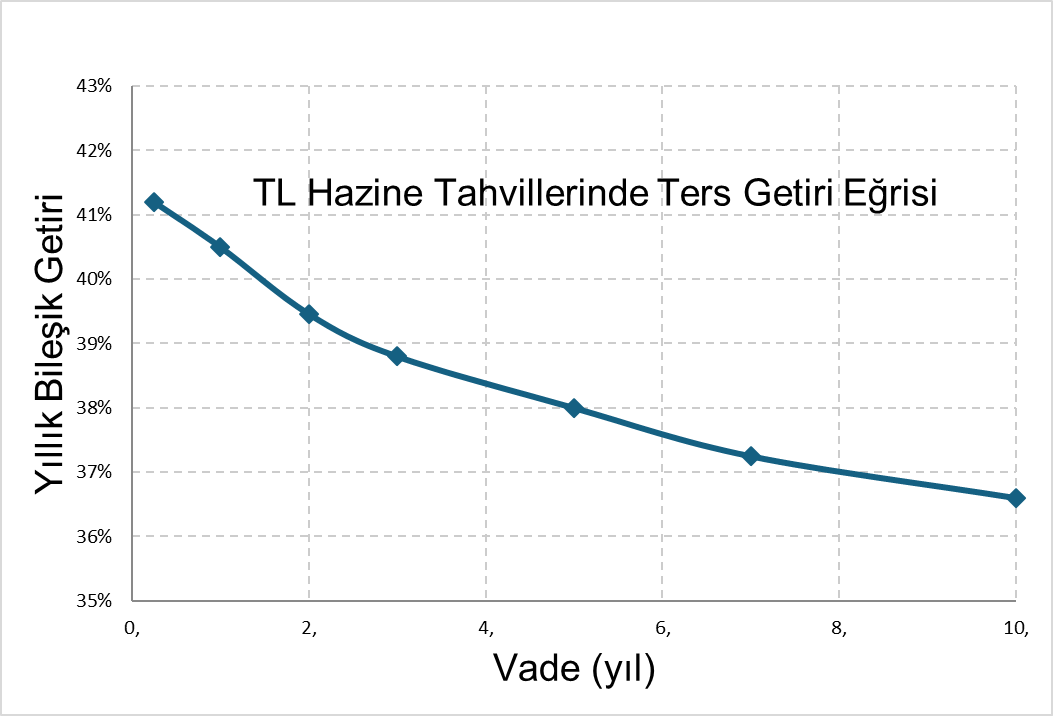
Two elements have to be considered together when reading the shape of the curve. The first is the market’s expectation of future short-term rates. If investors expect inflation and the policy rate to decline in the years ahead, long yields can sit below today’s short yields. The second is the maturity premium. That premium reflects the extra return an investor requires for bearing interest-rate and inflation uncertainty for a long time. Bond supply and investor demand can also affect the maturity premium. A downward-sloping curve can therefore be consistent with an expectation that rates will fall. Estimating how large a decline the market expects also requires an estimate of the maturity premium.
For corporate finance, the yield curve is a starting point for assessing borrowing costs at different maturities. When a five-year lira loan offer is examined, the yield on the five-year lira Treasury bond provides a market benchmark in the same currency and maturity. The company’s all-in cost is then calculated by taking account of its own credit risk, collateral terms, repayment schedule and fees.
Table 4. Selected bond yields as of 17 November 2026
| Maturity | Turkish lira Treasury | US Treasury |
|---|---|---|
| 2 years | 39.46% | 4.79% |
| 5 years | 39.43% | 4.90% |
| 10 years | 36.60% | 5.10% |
The nominal gap between Turkish and US yields should not be read directly as credit risk. Currency, inflation, central-bank policy and the structure of the bond markets differ. A more meaningful starting point is to compare similar-maturity instruments in the same currency, or real yields stripped of the inflation effect.
The inverse relationship between the price and the yield of a discount note can be seen in a simple example. A note that pays 100 lira in one year, bought at 71.70 lira, yields 100 / 71.70 − 1 ≈ 39.47 per cent. If the price rises to 75 lira, the yield falls to 33.33 per cent. On a coupon bond, too, the rate that equates the coupon and principal payments to the market price is the yield to maturity.
5. The Rate a Bank Charges Its Customers
The loan rate a bank offers a company is not a rate equal to the policy rate. The bank weighs together the cost of deposit, money-market and central-bank funding, reserve requirements, the use of capital, operating expenses, the loan’s maturity and collateral, the borrower’s cash flow, and the target profit. The company’s true cost is formed by adding fees, tax, insurance and other charges.
5.1. Flow and stock rates
The flow rate is the average, weighted by transaction amount, of new deposits opened or new loans extended in a given week. The stock rate reflects the contractual rates on existing balances. A rise in the weekly rate on new loans therefore does not mean that the company’s old loan is automatically repriced in the same week.
Table 5. A selected view of rates on new loans and deposits
| Week of 6 November 2026 | Annual average | Note |
|---|---|---|
| Turkish lira deposits, total | 42.04% | A decline of 2 basis points. |
| Turkish lira deposits, up to 3 months | 42.47% | The highest rate among the lira deposit maturities in the table. |
| Turkish lira deposits, 1 year and over | 38.12% | Longer-term deposits are priced lower. |
| Turkish lira commercial loans | 53.07% | Including overdrafts and corporate cards; a rise of 281 basis points. |
| Commercial loans, excluding overdrafts and cards | 46.25% | Closer to the average on a standard commercial cash loan. |
| Personal / housing / vehicle | 59.20% / 41.33% / 39.16% | Flow averages for consumer loans. |
| Dollar / euro commercial loans | 8.19% / 7.17% | Exchange-rate risk should be assessed separately. |
5.2. Comparing a commercial loan offer
The headline average for Turkish lira commercial loans is 53.07 per cent and the deposit average is 42.04 per cent; the gap is 11.03 percentage points. Excluding overdrafts and corporate cards, the commercial-loan average falls to 46.25 per cent and the gap with deposits to 4.21 points. These gaps are averages of different groups of transactions; they should not be read as the margin on a single loan offer.
To compare two offers, a company should use the same loan amount, the same maturity, the same payment calendar and the same collateral structure. If there is an upfront fee, an arrangement fee or insurance, the principal written in the contract and the net amount the company receives are not the same.
A loan repaid in equal principal instalments and a loan whose principal is repaid at maturity should not be compared by the advertised annual rate alone. The drawdown and repayment dates of both offers are written down; fees and taxes are added to the cash flows; the internal rate of return that equates the net amount drawn to the future payments is used as the common measure of cost.
The rule is clear: the discount rate that equates the present value of the cash inflows created by the loan relationship to the present value of the cash outflows is the cost of that loan.
5.3. The cost of a foreign-currency loan
As of 17 November 2026, the average rate on new dollar commercial loans is 8.19 per cent and on euro loans 7.17 per cent. For a company with lira revenue, however, a foreign-currency loan is not merely 8.19 per cent interest. The date and the exchange rate at which interest and principal will be converted into lira, the cost of hedging exchange-rate risk, and the company’s foreign-currency revenues have to be considered together.
For a dollar loan at 8.19 per cent a year, with principal and interest paid once at year-end, a 30 per cent rise in the dollar/lira rate during the year produces a lira cost factor, excluding charges, of 1.0819 × 1.30 = 1.4065, or approximately 40.65 per cent. At a 40 per cent rise in the exchange rate the cost rises to approximately 51.47 per cent.
Break-even lira depreciation ≈ (1 + lira interest) / (1 + foreign-currency interest) − 1
With a Turkish lira commercial-loan rate of 46.25 per cent and a dollar loan rate of 8.19 per cent, the break-even rise in the exchange rate is approximately (1.4625 / 1.0819) − 1 = 35.18 per cent. That rate shows, only under the example’s single-payment and no-charge assumptions, at what exchange-rate increase the two options are equal.
5.4. The annual equivalent of a monthly credit-card rate
The maximum monthly contractual rate is the highest interest rate the bank may apply, under the contract, to the relevant debt for one month. Contractual means based on the contract; maximum means an upper limit. The Central Bank of the Republic of Türkiye (CBRT) announces this ceiling. The bank may apply a rate below the ceiling.
Where is it used? It sets the upper limit on interest when part of a credit-card purchase balance is carried to the next month, when a cash advance is drawn, or when money is withdrawn from an overdraft account. In the CBRT table the ceilings can differ by type of transaction and, for personal cards, by the band of the statement balance.
If a monthly rate is to be compared with an annual cost, the calculation should follow compound interest. As of 1 November 2026, the annually compounded equivalents of the contractual ceilings are as follows:
Table 6. Annually compounded equivalent of the maximum monthly rates
| Transaction | Maximum monthly contractual rate | Maximum monthly late-payment rate | Annually compounded rate |
|---|---|---|---|
| Statement balance below 30,000 lira | 3.25% | 3.55% | 46.78% |
| 30,000–180,000 lira | 3.75% | 4.05% | 55.55% |
| Above 180,000 lira and corporate cards | 4.25% | 4.55% | 64.78% |
| Cash withdrawal and overdraft | 4.25% | 4.55% | 64.78% |
| Foreign-currency card | 2.98% | 3.28% | 42.24% |
Annually compounded rate = (1 + monthly rate)12 − 1
6. Statutory Interest Rates
If interest is payable by law and the parties have not set a rate in the contract, statutory interest applies. When a monetary debt is not paid at maturity, the question is whether the debtor has fallen into default. If default has arisen, the default interest that comes into play rests on the delay in payment.
The rate of default interest depends on the source of the debt. In ordinary affairs, the general default-interest provisions of Law no. 3095 are the basis. In commercial affairs, the same law’s provision on commercial default can, when its conditions are met, allow a different rate. If the debt arises from the supply of goods or services between commercial enterprises, it must also be considered whether the special late-payment provisions of Article 1530 of the Turkish Commercial Code apply. If, for example, the price of goods delivered by a supplier is not paid at maturity, whether the transaction falls within that article affects the interest calculation.
Determining the applicable rate therefore begins with the reason the interest arises, the transaction from which the debt originates, and whether the contract contains a valid interest clause. The relevant statutory provision and the period on which the interest calculation is based are then identified.
If the contract does not set an interest rate, or if a monetary debt is not paid at maturity, the applicable rate is determined under the relevant statutory provision.
6.1. Rediscount and advance rates
Rediscount is a bank’s re-discounting at the CBRT, before maturity, of a note it has already discounted into cash. The discount for the remaining term is deducted from the face amount and the bank receives the balance today. In an advance transaction the bank borrows cash by pledging an eligible instrument as collateral. Interest is calculated not on the note’s maturity value but on the amount of credit extended.
These two rates are also used in setting statutory interest. Under Law no. 3095, statutory interest is as a rule calculated as 80 per cent of the short-term rediscount rate in force on the last day of the previous year. For commercial default interest, the CBRT’s short-term advance rate may be used when the conditions in the law are met.
In tax practice, rediscount means reducing a receivable or payable tied to a note that has not yet matured to its value on the valuation date.
6.2. Statutory interest and default
Statutory interest for the period 31 July 2026 to 31 December 2026 is 31 per cent. The calculation takes 80 per cent of the 38.75 per cent rediscount rate in force on 31 December 2025: 38.75 × 0.80 = 31. If a receivable spans more than one rate period, each period should be calculated with its own day count.
Table 7. Statutory interest regimes included in the compilation
| Period / regime | Annual rate | Where it is used |
|---|---|---|
| 1 January 2006 – 31 May 2024 | 9% | The former statutory-interest period. |
| 1 June 2024 – 30 July 2026 | 24% | The period of decision no. 8485. |
| 31 July 2026 – 31 December 2026 | 31% | 80 per cent of the 38.75 per cent rediscount rate. |
| Default in ordinary affairs | 31% | Default on a monetary debt, unless contractual interest is higher. |
| Commercial default | 39.75% | When the advance rate is above the statutory rate. |
| TCC Art. 1530 late payment | 43% | A special rate on the commercial supply of goods and services. |
The rate applicable to foreign-currency debts should be researched in a manner consistent with the currency of the debt and the bank-deposit-rate criterion required by the relevant legislation. Although the weekly average on dollar deposits is given as 2.90 per cent, that statistic is not automatically the same as the legal default rate on a foreign-currency receivable.
7. Reference Rates: TLREF, TRLIBOR, LIBOR and SOFR
Understanding the cost of a floating-rate loan requires looking at how the contract uses the reference rate. In a “TLREF + 3 per cent” clause, TLREF is the part that moves with market conditions and the 3 percentage points are the fixed margin set by the bank in the contract. If the TLREF used in the calculation is 40 per cent a year, the loan rate is 43 per cent. If at the next reset TLREF falls to 35 per cent, the loan rate falls to 38 per cent.
The contract may take the TLREF of a specified day. The rate is then fixed on the observation date stated in the contract. The contract may also use the compounded equivalent of the daily TLREF rates published through the interest period. In that method, daily rates during the period are taken into account instead of a single day’s rate, and the period’s interest becomes final when the last relevant daily rate is known.
The contract should also be read for the dates on which interest resets and for the fallback rate or calculation method if TLREF cannot be published. Those clauses determine when the company can calculate the interest it will pay and when a change in market rates will pass through to the loan payments.
7.1. The distinction between TLREF and TRLIBOR
TRLIBOR was an indicator based on quotations submitted by panel banks for specified maturities, and it was last published on 30 June 2022. TLREF is a rate published by Borsa İstanbul since 17 June 2019, based on realised overnight repo transactions secured by domestic government securities.
Table 8. The different domains measured by Turkish lira interest-rate indicators
| Indicator | Data source | The contractual question |
|---|---|---|
| TLREF | Secured overnight Turkish lira repo transactions | How will daily rates be compounded into period interest? |
| CBRT policy rate | One-week repo auction | How will a rate change pass through to the loan’s reset date? |
| Weighted funding cost | Amount-weighted average of CBRT funds | How is the bank’s actual funding mix composed? |
| Two-year bond yield | Secondary-market bond price | Is the comparison appropriate for borrowing of the same maturity and currency? |
Three questions stand out when an old TRLIBOR contract is examined: which indicator will be used, how period interest will be calculated from daily rates, and how any transition spread will be added to the loan margin. The transition spread is intended to offset the effect of the change in reference on the cash flow; the method applicable to a particular loan should be read from the contract.
7.2. Indicators after LIBOR
LIBOR’s structure, based on panel quotations, was criticised as the underlying transactions became sparse in some currencies and maturities. The last synthetic dollar LIBOR rates were published on 30 September 2024. The principal alternatives are SOFR for the US dollar, SONIA for sterling, €STR for the euro, TONA for the yen and SARON for the Swiss franc.
SOFR measures overnight dollar repo transactions secured by US Treasury securities. In a dollar loan of the form “SOFR + margin”, the margin may cover company risk, country risk, maturity, collateral and the bank’s costs. EURIBOR is a separate term reference for unsecured funding in euro and continues to be used after the end of euro LIBOR.
8. The Prime Rate and International Indicators
The US prime rate is a loan-pricing benchmark that banks use especially when pricing loans to commercial customers of high credit standing. If prime is 7 per cent and the contractual margin is 1.5 points, the loan rate is 8.5 per cent. Prime does not measure the same thing as SOFR: SOFR relates to secured overnight market transactions, prime to banks’ loan-pricing decision.
Table 9. Selected international indicators as of 17 November 2026
| Indicator | Rate | Economic meaning |
|---|---|---|
| US prime rate | 7.00% | The published benchmark banks use in pricing commercial loans. |
| US effective federal funds rate | 3.88% | The realised rate on unsecured overnight federal funds transactions. |
| SOFR | 3.93% | The reference rate of the secured overnight dollar repo market. |
| US 2-year Treasury | 4.79% | The market yield on roughly two-year government debt. |
| US 10-year Treasury | 5.10% | The market yield on long-term government debt. |
| Türkiye policy rate | 36.00% | The one-week repo auction rate. |
The gap between Türkiye’s 36 per cent policy rate and the US prime rate of 7 per cent is not, in itself, the difference between a company’s lira and dollar loan costs. A single cross-country comparison of rates should not be made before the reference rate, the margin, the payment schedule and the exchange-rate assumption in the company’s own offer have been examined together.
9. A Decision Framework for Corporate Financing
When a financing offer is assessed, the first step is to determine which need will be financed, for how long, and in which currency. A three-month loan used to buy inventory and a five-year loan used for a new production plant involve different payment schedules and risks. The benchmark is chosen according to those differences.
For short-term Turkish lira working-capital finance, the appropriate market benchmark is the flow rate on newly extended lira commercial loans of similar maturity and collateral. The flow rate gives an idea of the loan price the company may face today. When bank offers are compared, the net amount the company receives on the day the loan is drawn is assessed together with every payment, including principal, interest, fees and tax. A lower-rate offer can be more expensive because of a high upfront fee. If the offers require payment on different dates, the annual effective cost calculated from those cash flows puts the comparison on a common basis.
For long-term Turkish lira investment finance, the yield on a Treasury bond of the same currency and a similar maturity is a starting point for the cost of borrowing. The yield on a five-year corporate bond, for example, can be assessed against the five-year Treasury yield plus the company’s credit margin. That margin reflects the company’s repayment risk, the collateral and the liquidity of the instrument. If a bank loan is used, the instalment structure and the charges also affect the all-in cost. The cost of borrowing and the discount rate for the investment are calculated separately. The cost of borrowing shows the terms on which the company obtained the funds. When the cash flows from the project’s operations are valued, a cost of capital consistent with the project’s risk is used.
In foreign-currency borrowing, the lira equivalent of principal and interest is calculated together with the loan rate. If, for example, principal and interest on an 8 per cent dollar loan are paid once at year-end and the dollar/lira rate rises by 25 per cent during the year, the lira cost of borrowing, excluding charges, is 35 per cent. (1.08 × 1.25) − 1 = 35 per cent.
If the company fixes the exchange rate with a forward transaction, the rate fixed by the contract, and any transaction costs, are used instead of the estimated rate on the payment date. If the company has regular income in the same currency, debt service that can be met from that income reduces exchange-rate risk. Collection and payment dates need to match for that to work.
9.1. A step-by-step analysis of a Turkish lira loan offer
- Write down the offer’s basic parameters: loan amount, net drawdown, maturity, type of interest, payment frequency, the form of principal repayment, and collateral.
- Put the interest rate on the same basis: determine whether it is nominal or effective, simple or compound, annual or monthly.
- Add fees, the arrangement charge, insurance, tax, fund levies and other costs to the cash flow.
- Separate the loan amount from the net amount the company receives; compare offers on the net drawdown.
- Calculate the annual cost rate, or the internal rate of return, using all payment dates.
- If the rate is floating, stress-test the clause that governs reset and compounding of the reference rate. What is meant is to calculate, under different scenarios, when a rise in the reference rate will pass through to the loan and by how much it will increase the interest payment. In the stress test the contractual rules are applied as written and the path of the reference rate is varied. The reset clause determines when the new rate will pass through to the loan. If, for example, the loan rate is set every three months on TLREF at the start of the period, a rise in TLREF during the period does not change that period’s interest. The increase passes through to the payment on the next reset date, at the TLREF then in force.
9.2. Comparing a lira loan and a dollar loan
A company whose income is predominantly in lira should convert the interest and principal of a dollar loan into lira at each payment date under different exchange-rate scenarios. Companies with regular dollar income may have a natural hedge, but the maturities of income and debt need to match. The cost of hedges such as forwards, swaps or options should also be included in the total financing calculation.
Table 10. An illustrative scenario analysis for a lira loan and a dollar loan
| Assumption | Lira loan cost | Lira cost of the dollar loan | Comment |
|---|---|---|---|
| Lira interest 46.25%; dollar interest 8.19% | 46.25% | 8.19% + exchange-rate effect | The rise in the exchange rate compounds separately. |
| Exchange-rate increase of 30% | — | 40.65% | Single-payment example, excluding charges. |
| Exchange-rate increase of 40% | — | 51.47% | Rises above the lira loan rate. |
| Break-even exchange-rate increase | — | 35.18% | A simplified assumption with no charges. |
9.3. The cost of debt and the after-tax cost
For the long-term cost of Turkish lira debt, the yield on a government bond of the same maturity can be the starting benchmark. The company’s default and liquidity risk, bank expenses, the use of capital and the tax effect are then added. If interest expense is deductible from the tax base and the company can actually use that deduction, the approximate after-tax cost of debt can be written as:
After-tax cost of debt ≈ cost of debt × (1 − corporate tax rate)
If there are restrictions on the interest deduction, a low tax base, or deferred-tax effects, this expression can overstate the real advantage. The legislation and the company’s tax capacity should therefore be checked separately in the financial model.
9.4. The interest budget and the amount that can be borrowed
An annual interest budget can be divided by the interest rate as a simple first indication of capacity. For an annual interest budget of 100 million lira, principal is calculated approximately as 100 / rate. This is a simplified approach that does not include principal repayments, fees or fluctuations in cash flow.
Table 11. The arithmetic equivalent of an interest budget at different rates
| Rate | Approximate principal carried by a 100 million lira interest budget |
|---|---|
| Policy rate 36.00% | 278 million lira |
| 2-year bond 39.46% | 253 million lira |
| Turkish lira deposits 42.04% | 238 million lira |
| Commercial loan, excluding overdrafts, 46.25% | 216 million lira |
| Commercial loan, headline, 53.07% | 188 million lira |
| Personal loan 59.20% | 169 million lira |
9.5. Refinancing risk and crowding out
When a long-lived asset is financed with a short-term source, the company has to roll the debt more than once. At each rollover there is a risk that funds cannot be found, or can be found only at a higher rate. Even if the yield on a long-term government bond looks low, it should not be assumed that the company can find long-term funds at the same maturity and with suitable collateral.
When government bond yields rise, banks’ shift toward public debt instruments can narrow the long-term funds available to the private sector. This mechanism is called crowding out. Whether a particular loan will be granted is determined not by the bond yield alone, but by collateral, credit risk, the cost of capital and the bank’s expected total return.
9.6. The discount rate and investment valuation
The present value of a project is found by bringing future cash flows to today at an appropriate discount rate. Discounting 100 lira to be received in ten years at 10 per cent gives a present value of approximately 38.55 lira; discounting it at 36 per cent gives approximately 4.62 lira. Cash flows further in the future are more sensitive to the discount rate.
The discount rate should be consistent with the currency of the cash flow and its inflation content. Nominal lira cash flows are discounted at a nominal lira rate; real cash flows stated in constant prices are discounted at a real rate. The interest rate on debt is not, by itself, the measure of the discount rate to be chosen for a project; a cost of capital consistent with project risk and capital structure is determined separately.
10. Interest Concepts That Are Often Confused
Table 12. A quick reference to the concepts
| Distinction | The correct reading |
|---|---|
| Policy rate / benchmark bond yield | The first is the one-week repo rate announced by the committee; the second is the roughly two-year yield priced every day in the secondary market. |
| Nominal / effective | Nominal is the annual quotation in the contract; effective is the annual equivalent calculated with intra-year compounding and a reinvestment assumption. |
| Nominal / real | The real rate is stripped of inflation; at high rates the Fisher equation should be used rather than simple subtraction. |
| Realised / expected inflation | Realised inflation is used in measuring the outcome; expected inflation is used in the forward-looking calculation at the moment of decision. |
| Flow / stock rate | The flow rate is the rate on new transactions; the stock rate is the rate on existing balances. |
| Headline / commercial loans excluding overdrafts | 53.07 per cent includes cards and overdrafts; 46.25 per cent is closer to a standard commercial cash loan. |
| Statutory interest / policy rate | Statutory interest rests on a legal provision; the policy rate rests on a monetary-policy decision. |
| TLREF / TRLIBOR | TRLIBOR was a quotation-based indicator that has ended; TLREF is the realised secured overnight repo rate. |
| LIBOR / SOFR | LIBOR was an unsecured panel quotation; SOFR measures secured overnight dollar transactions. |
| CDS / Turkish lira bond yield | The CDS reflects the credit-protection premium on foreign-currency debt; the lira bond yield jointly reflects lira and local-market risks. |
11. A Practical Guide for the Company
For a company assessing a bank loan offer, a practical decision framework can be built in the following order:
- First determine the currency and the economic life of the cash need the loan is meant to finance.
- Choose as the starting benchmark the market flow rate on loans of the same maturity, collateral, repayment and use.
- Use the policy rate as the short-term monetary-policy anchor, and the bond yield as the starting point for market borrowing at the same maturity.
- Separate the bank’s offer into reference rate + margin + charges.
- Calculate nominal and effective cost together on a lira loan; on a foreign-currency loan calculate interest, the exchange rate and the cost of hedging together.
- Run at least three scenarios: a base case, an adverse case and a stress case.
- On a floating-rate loan, include in the review of the contract the reset date of the reference rate and the fallback-indicator clause.
The rate the company needs to compare is, in most cases, not the policy rate. It is the all-in cost of loan transactions in the same currency, of a similar maturity, and with similar collateral and a similar payment schedule. The policy rate and the bond yield provide the context of that analysis; they do not stand in for the loan offer itself.
Conclusion
Reading interest rates correctly requires separating the transactions that the indicators represent, rather than selecting a single indicator. The policy rate shows the central bank’s one-week funding decision, TLREF the secured overnight repo market, the bond yield the market price of government debt of a given maturity, and the commercial loan rate the combination of the bank’s funding cost and the company’s risk.
When assessing a loan offer, the company should compare Turkish lira loans of similar maturity and collateral, and analyse the payment schedule through the net drawdown, fees, tax and total repayment. For foreign-currency options, interest and principal should be converted into lira under different exchange-rate assumptions, and the match between the currency of the company’s income and the currency of the debt should be examined separately. In investment valuation, the discount rate should be chosen consistently with the currency of the cash flow, its inflation content and its risk profile.
In a real financing decision, the date on which rates are in force, the contractual clause, the tax treatment, the bank’s tariff of charges, current market data and the relevant legislation should also be verified.
Comments
Comments are held for moderation and appear here only after approval. No account is required to comment.